Play Move Improve
Ready for Learning Program for Primary School and Literacy Support Teams
Ready for Learning Program for Primary School and Literacy Support Teams
Couldn't load pickup availability
Ready for
Learning
A Movement Program to Support Children with Self-Regulation and Focus in Primary School
Designed for PE teachers and specialists who already understand the power of movement and want a structured, evidence-based tool to bring that understanding into every classroom in their school.
You see it every week.
The child who cannot sit still long enough to hold a pencil. The one who shuts down the moment a transition happens. The student whose core is so underdeveloped they are leaning on their hands just to stay upright at their desk and their classroom teacher has no idea that is why they cannot focus.
As a PE teacher or movement specialist, you notice things classroom teachers often cannot. You see the bilateral coordination gaps, the vestibular sensitivities, the kids working twice as hard just to keep their body in the game. And you have probably spent years wishing there was a simple, practical way to bridge what you know about movement with what is happening in the classroom.
That is exactly what Ready for Learning was built to do.
-
●
6 to 13% of school-age children have poor motor coordination and most go unidentified until difficulties are well established. Hands et al. (2021), ScienceDirect
-
●
Motor difficulties affect a child's ability to sit still, focus, write, transition between tasks and regulate emotions, not just their physical performance. PMC (2020)
-
●
Since the pandemic, Australian children are showing elevated rates of hyperactivity, inattention, anxiety and emotional dysregulation compared to pre-2020 data. Westrupp et al. (2021), Journal of Pediatrics and Child Health
-
●
Better motor skills predict higher executive function, stronger social behaviours and better literacy and numeracy outcomes. Veldman et al. (2019), Early Human Development / PMC
What is Ready for Learning?
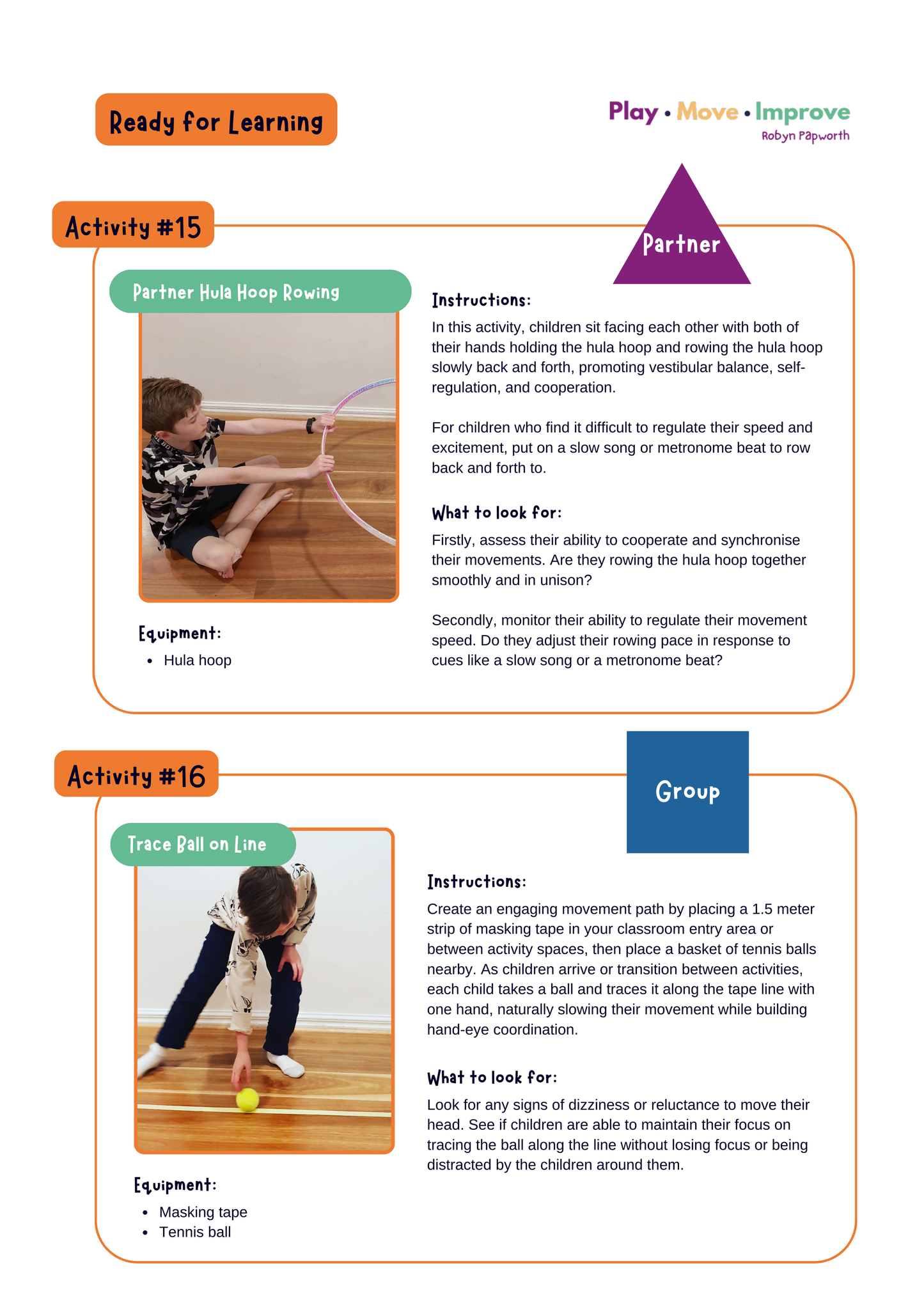
Ready for Learning is a structured 6 to 8 week movement and self-regulation program designed to be embedded into everyday school life. It bridges the gap between what you know as a movement specialist and what classroom teachers need, giving them practical tools they can actually use backed by the science you already trust.
The program is built around three interconnected areas that research consistently links to academic readiness.
Balance, spatial awareness and postural control. The physical foundation a child needs before they can sit still, track text or hold a pencil steadily.
Bilateral coordination, crossing the midline and proprioceptive awareness. The skills that underpin handwriting, sport and moving through a classroom without disruption.
Emotional regulation, attention, energy management and transition skills. The tools children need to learn and the tools teachers most want support with.
Each area is assessed at baseline and again at 6 to 8 weeks using the RFL Observation Checklist, giving you and your colleagues measurable, structured data on student progress.
What the research says about movement and learning
You already know this works. Here is the peer-reviewed evidence to back you up when making the case to your principal or leadership team.
-
●
58% reduction in off-task behaviour during physically active lessons compared to sedentary ones. Mavilidi et al. (2021), Trends in Neuroscience and Education
-
●
Active breaks of 5 to 10 minutes produce the strongest improvements in classroom concentration and attention, confirmed across a meta-analysis of 15 studies. Fenesi et al. (2018), Journal of Applied Research in Memory and Cognition; ScienceDirect (2024)
-
●
Students who took brief breaks retained 65.1% of content compared to 56.4% for peers in continuous lessons. Wach et al. (2025), Frontiers in Psychology
-
●
Postural stability is a prerequisite for handwriting. A child cannot develop fine motor precision until they can maintain an upright seated position. Flatters et al. (2014), PLOS ONE / PMC, study of 278 school-aged children
-
●
Strong correlation between fine motor skills and handwriting legibility, with precision identified as the key predictor of writing quality. Seo (2018), Journal of Physical Therapy Science / PMC
-
●
Fine motor skills in kindergarten predicted later achievement in both reading and mathematics, study of 2,714 children. Grissmer et al. (2010), Developmental Psychology / PMC
-
●
School-based physical activity significantly improved reading comprehension (SMD 0.24) and mathematics achievement (SMD 0.41) across a meta-analysis of 17 studies. Frontiers in Public Health (2025)
-
●
Fundamental movement skills are positively associated with numeracy, arithmetic and geometry through shared spatial reasoning pathways. Gu et al. (2024), PMC, study of 182 children aged 7 to 8
-
●
Self-regulation interventions improved academic achievement in 11 of 13 rigorously evaluated studies, across literacy, mathematics, reading and vocabulary. Pandey et al. (2018), JAMA Pediatrics / PMC
-
●
Early self-regulation skills predict long-term academic success, mental health, income and occupational outcomes. Blair and Raver (2015), Annual Review of Psychology
The RFL Observation Checklist
At the heart of the program is a structured observation tool that gives movement specialists and classroom teachers a shared language and shared data for tracking student development.
-
●
Vestibular Function — balance, spatial awareness, postural control
-
●
Body Awareness and Motor Control — bilateral coordination, midline crossing, proprioception
-
●
Self-Regulation and Focus — transitions, attention, emotional regulation, multi-step instructions
-
●
Energy Zones Tracking — monitoring arousal levels at the start and end of sessions
Completed at baseline and again at 6 to 8 weeks. Observations are made during regular PE classes and movement activities with no additional testing sessions required.
The checklist uses a three-symbol rating system designed to protect student confidence during assessment. An intentional choice that reflects the program's commitment to inclusive, strengths-based practice.
Aligned with Australian Teaching Standards and Victorian Priorities
Australian Professional Standards for Teachers (AITSL)
Physical, social and intellectual development and characteristics of students
Using a range of teaching strategies
Creating and maintaining supportive and safe learning environments
Engaging in professional learning and improving practice
Victorian Department of Education Priorities
-
●
Student wellbeing initiatives
-
●
Teacher professional development
-
●
Early intervention for learning and regulation difficulties
-
●
Inclusive education practices
Robyn can help you identify the most appropriate funding pathway for your school. Just ask.
Two ways to bring RFL into your school
Whether you want to run it yourself or bring in expert support, there is an option that fits your school's needs and budget.
School-Led Program
- Spiral-bound resource guide
- 48 evidence-based movement activities
- RFL Observation Checklist
- 6-week implementation plan
- Family engagement resources
- Online professional learning community
- Step-by-step progress tracking tools
Expert-Led Program
- 8-week intensive program
- Led by trained Early Childhood Teachers
- Weekly 40 to 45 minute movement sessions
- Curriculum-aligned delivery
- Hands-on professional development for teachers
- Baseline and progress checklist assessments
- Ongoing support and consultation
Try this with your class this week.
Here is one of the 48 activities from the Ready for Learning guide. No equipment, no prep, three minutes.
Students stand beside their desks. Alternating sides, they tap their right hand to their left knee, then left hand to right knee, like a slow march. Call out a countdown from 20 and encourage students to stay in rhythm. For an added challenge, have them count by 2s or say the alphabet while they move.
If that landed well with your students, there are 47 more where that came from. Each one just as practical and just as easy to hand to a classroom teacher on a Monday morning.
Ready to bring this into your school?
You are already doing the hard work of understanding how children's bodies and brains connect. The Ready for Learning program gives you the structured tools to make that knowledge count in every classroom, for every student who needs it.
Whether you want to order the School-Led guide, discuss the Expert-Led program, explore funding options or simply ask a question, Robyn responds personally to every enquiry.
📩 robyn@playmoveimprove.com.au 🌐 www.playmoveimprove.com.auCreated by Robyn Papworth · Paediatric Exercise Physiologist · Masters Qualified Development Educator
Share